

The New Geography of Trust: Why Wealthy Americans Are Redefining Mobility - From Passport Power to Data Intelligence
Updated: May 3

For decades, global mobility was a question of possession.
The right passport—preferably one embossed with the seal of a stable Western democracy—was the ultimate instrument of freedom.
Rankings quantified that privilege, reducing mobility to a clean hierarchy of visa-free destinations.
That framework is now breaking down.
A growing number of wealthy Americans—long the beneficiaries of one of the world’s most powerful passports—are quietly rethinking the meaning of mobility itself. Their movement is no longer driven by access, but by uncertainty. And increasingly, by something far less visible: the integrity of their data.
-----------------------------------------------------------------------------------------------
My Covid narrative is experiential during July 2020 to late 2022. The unraveling of that system was not abstract. It played out at airports, borders, and train stations—where mobility was suddenly governed less by passports than by data.
As Europe tentatively emerged from the first phase of the coronavirus crisis, Greece—an economy heavily reliant on tourism—reopened its borders on July 1, 2020, becoming one of the first countries to do so. After months of confinement in Paris, I booked a flight to Athens on that very day, expecting a symbolic return to mobility.
Instead, it marked the beginning of a new kind of constraint.
At Paris’s Gare du Nord, access to the train required lengthy verification of newly introduced health documentation—QR codes, declarations, and mobility forms that were still poorly standardized. By the time I reached Charles de Gaulle Airport, the process had multiplied: health QR codes, vaccination records, and certified translations in English were all required, each subject to manual scrutiny. The system was fragmented, evolving in real time, and often contradictory.
Despite arriving early, I missed my flight on that first day of reopening.
The following morning, departing several hours ahead of schedule, I finally reached Athens—but only after navigating a succession of overlapping requirements. Upon arrival, it became clear that European coordination was still incomplete: Greek authorities required their own national QR code, separate from French documentation, reflecting the absence of a unified system.
Travel had become a negotiation between jurisdictions.
Airlines, too, operated within this ambiguity. Carriers demanded departure country certifications, often duplicating procedures. Departing Athens, passengers were required to obtain additional Greek health clearance by unpredicted policy changement, involving delays of up to 24 hours. Returning to Paris did not simplify matters. By the time of arrival, French regulations had already shifted again overnight, requiring further verification at the border.
Mobility had not disappeared—but it had become conditional, procedural, and increasingly mediated by digital systems that were neither harmonized nor stable.
Between July 2020 and late 2022—when Japan, among the last major economies, fully reopened—travel was defined less by geography than by compliance. Each border crossing meant adapting to a new set of compliance rules, often updated overnight. In countries such as Romania, Turkey, Georgia, and Armenia throughout 2021, the experience repeated itself: algorithmic checks, shifting requirements, and a growing reliance on automated verification systems.
What emerged was not simply a health protocol, but a preview of a broader transformation.
Mobility was no longer governed solely by the passport one carried, but by the data one could produce—and the systems that interpreted it.
-----------------------------------------------------------------------------------------------
From Privilege to Precaution
The shift is measurable. Americans, once peripheral in the investment migration market, now dominate it. According to industry data, they represent the fastest-growing client segment for nearly half of global advisory firms, with some reporting that U.S. citizens account for over 30% of applications in 2025 .
This is not a reaction to a single election cycle or policy shock. It is structural.
Historically, investment migration was driven by constraint. Applicants from countries with limited visa access sought second citizenships to unlock global travel. Americans, by contrast, already possess extensive mobility rights. Their motivations are therefore different—and more revealing.
They are not buying access. They are buying optionality. Political polarization, rising living costs, healthcare concerns, and a perceived erosion of institutional stability are frequently cited. But beneath these surface drivers lies a deeper recalibration: mobility is no longer about where you can go, but whether you can go when it matters.
The End of the Passport Index Era
For years, thought leadership in global mobility revolved around the passport index—a league table of geopolitical privilege. It was intuitive, visual, and comforting in its simplicity.
But it is increasingly obsolete.
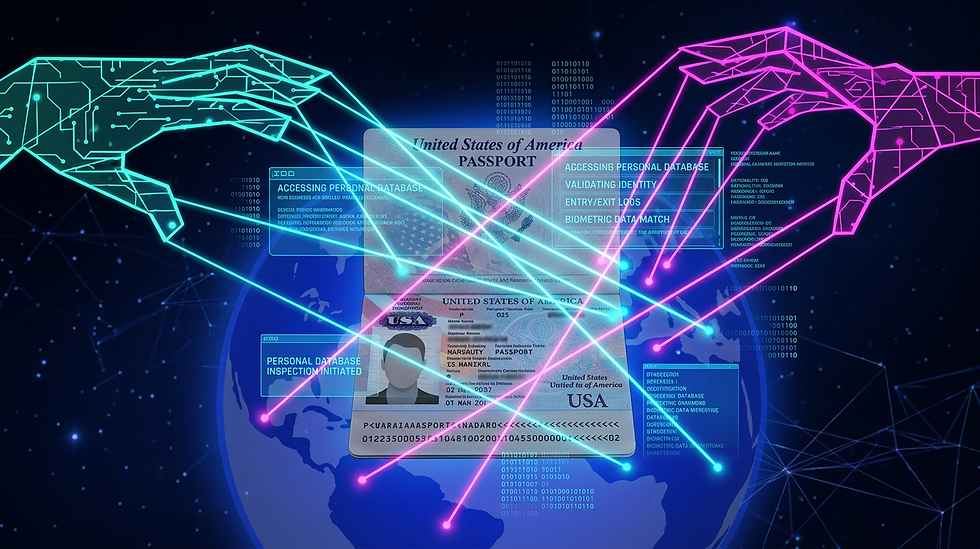
What passport rankings fail to capture is risk. Not geopolitical risk in the traditional sense, but algorithmic risk—the probability that a traveler will be flagged, delayed, or denied not by a border officer, but by a system.
Governments have quietly shifted border control upstream. Systems such as pre-travel authorizations, biometric databases, and passenger data analytics now assess individuals before they ever approach a checkpoint. The decision is made earlier, faster, and with less transparency.
Mobility is no longer adjudicated at the border. It is computed in advance.
The Rise of the “Trust Score”
In this new paradigm, the decisive variable is not nationality, but what might be called a “trust score”: a composite of data signals generated across financial systems, travel histories, institutional affiliations, and digital records.
These signals are continuously cross-referenced against security databases, regulatory frameworks, and historical patterns of risk. The process is largely opaque, shielded under the logic of national security.
The implications are profound.
A traveler with a top-tier passport but inconsistent or “noisy” data may face greater friction than someone with a weaker passport but a clean, predictable digital footprint. In effect, identity is being redefined—not as citizenship, but as a data profile.
The border, once a physical threshold, has become an algorithm.
When Strong Passports Fail
This shift is no longer theoretical. Even holders of the world’s most powerful passports are encountering friction that traditional metrics fail to predict.
Consider three illustrative cases drawn from advisory practice and industry reporting:
A U.S. technology executive—holder of a passport consistently ranked among the top globally—was denied boarding on a transatlantic flight due to a mismatch between booking records across separate airline systems. No visa issue, no legal violation. The system produced a binary outcome: no clearance, no travel.
A German entrepreneur, operating across multiple jurisdictions, faced repeated secondary screenings within the European Union after his financial transactions triggered automated compliance flags linked to counterparties in higher-risk jurisdictions. His passport granted him full rights of movement; his data profile did not.
A Singaporean investor—citizen of one of the most visa-free-access countries in the world—experienced delays in travel authorization after inconsistencies appeared across identity verification systems tied to multiple residences and banking relationships. The issue was resolved, but only after weeks of administrative friction.
None of these cases involved weak passports. All involved strong ones.
What they share is something else: data inconsistency.
In each instance, mobility was not constrained by nationality, but by how fragmented or anomalous the individual’s data appeared when processed by automated systems. The passport opened the door; the data quietly closed it.

China and the Architecture of Digital Sovereignty
Nowhere is this transformation more explicit than in China.
Under the governance framework associated with Xi Jinping, data has been elevated from an administrative tool to an instrument of sovereignty.
As analyzed in Toward a Digital Sovereignty?

China’s Governance of Data and Cyberspace, China’s model treats data not merely as information, but as a strategic asset through which the state governs both population behavior and cross-border flows.
This approach reframes mobility itself.
Rather than being anchored in citizenship, mobility is embedded within a broader national security architecture, structured around three pillars:
Data localization, ensuring that critical personal and financial data remain within sovereign control
Unified identity systems, linking individuals across administrative, financial, and social domains
Cross-border data controls, regulating not only the movement of people, but the movement of information associated with them
In such a system, the border is no longer a checkpoint—it is a continuous process of verification.
The implications are direct and unambiguous.
Mobility is not treated as an inherent right attached to a passport. It is a conditional privilege, contingent on data compliance.
China has already operationalized what many Western systems are only beginning to approximate.
Invisible Walls, Real Consequences

These developments are giving rise to what can be described as “invisible walls”: digital barriers that are harder to detect, harder to contest, and often impossible to appeal.
Unlike traditional visa denials, which at least offer procedural clarity, algorithmic decisions are binary and silent. A mismatch in travel records, an anomalous financial transaction, or an association with a flagged jurisdiction can trigger automated restrictions.
There is no conversation, no discretion—only outcome.
For high-net-worth individuals operating across jurisdictions, the risks are not theoretical.
A single data inconsistency can disrupt business continuity, delay transactions, or block mobility at critical moments.
In this context, the second passport is no longer a symbol of status. It is an insurance policy against systemic opacity.
The New Logic of Diversification
The destinations attracting American capital reflect this shift. Portugal, Greece, New Zealand, Italy, and Panama are not merely lifestyle choices; they are nodes in a broader strategy of jurisdictional diversification .
These programs offer more than residency or eventual citizenship. They provide alternative legal identities, access to different regulatory ecosystems, and, crucially, separation from a single national data profile.
In financial terms, this is hedging. In mobility terms, it is redundancy.
From Passport Power to Data Intelligence
The implications extend beyond migration trends. They signal a fundamental reordering of how states exercise sovereignty in a digital age.
Where borders were once lines on a map, they are now distributed systems of verification. Where identity was once conferred by documents, it is now inferred from data.
The thought leaders of the past decade focused on passport strength. Those of the next will focus on data intelligence.
The question is no longer: Where can your passport take you?
It is: What does your data say about you before you even leave home?
This transition is happening largely out of public view. There are no dramatic policy announcements, no visible infrastructure. Yet the effects are cumulative and irreversible.
The infrastructure of algorithmic borders is already in place.
For wealthy Americans—and increasingly, for global citizens at large—the challenge is adapting to a world where mobility is conditional not on status, but on signal integrity.
The invisible walls are already up.
And in this new geography of trust, the strongest passport in the world may no longer be enough.
(By Hyong-jin Kwon, Paris on April 6, 2026)


Comments